The unified strategy for transitioning your business from search results to the definitive answer.
AI engines now decide which brands get recommended before buyers ever reach a website. The decision happens inside training data most companies have never audited, shaped by signals most agencies do not understand. ChatGPT, Perplexity, Claude, Gemini, and Google’s AI Overviews are no longer pointing users to ten blue links. They are issuing definitive answers, and your brand is either inside those answers or invisible to the buyer.
Gartner forecasts a 25 percent decline in traditional search volume by 2026 as users shift to AI-native discovery. Brandlight’s 2026 research shows the overlap between top Google rankings and AI-cited sources has dropped from roughly 70 percent to under 20 percent. The implication is direct: ranking number one in Google no longer guarantees a citation in ChatGPT.
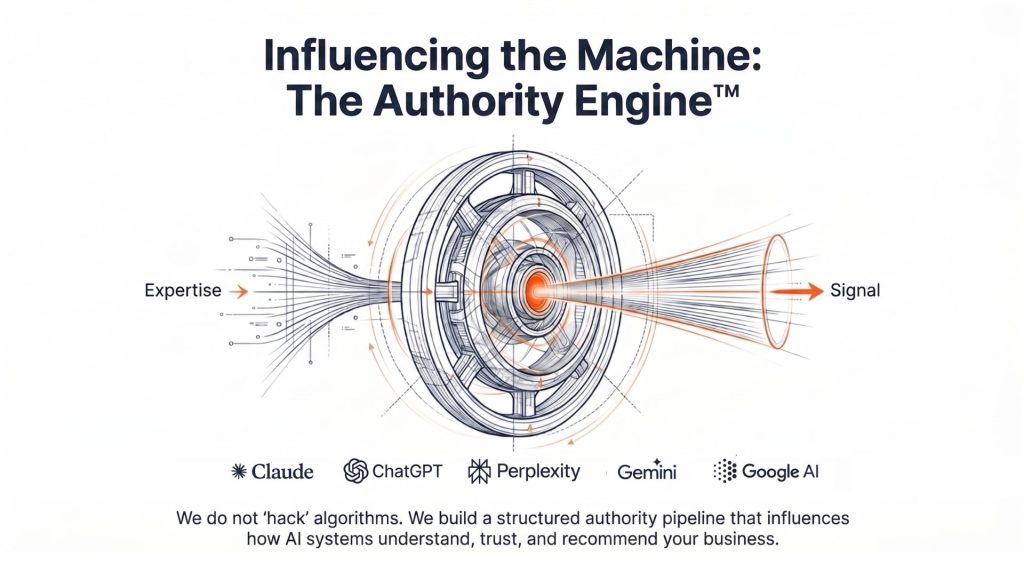
AI Search Authority Engine™ is JAR Consulting Group’s proprietary methodology for engineering how artificial intelligence systems understand, trust, and recommend a business. It is a structured authority pipeline. Not a tactical optimization, not a content campaign, and not a search engine optimization service with new vocabulary applied to it.
The methodology operates on a simple premise: AI engines do not calculate truth, they calculate probability. They infer authority from repeated, consistent signals across the public record they have been trained on. A brand that appears with consistent identity, demonstrated expertise, and corroborated reputation across that record becomes a probabilistic favorite. A brand that appears inconsistently, sparsely, or not at all becomes invisible.
AI Search Authority Engine™ engineers those signals deliberately. The methodology produces the public record AI relies on, structures it for machine ingestion, and distributes it across the platforms AI engines weight most heavily. The outcome is a brand that ChatGPT, Claude, Perplexity, Gemini, and Google AI Overviews cite as a recognized expert when buyers ask the questions that matter.
Once the entity is recognized, AI engines weigh what the entity has actually published, claimed, and substantiated. This is the layer of original research, named methodology, documented case work, and substantive content depth on specific topics. Generic marketing language fails this layer; specific, dense, definition-first content passes it.
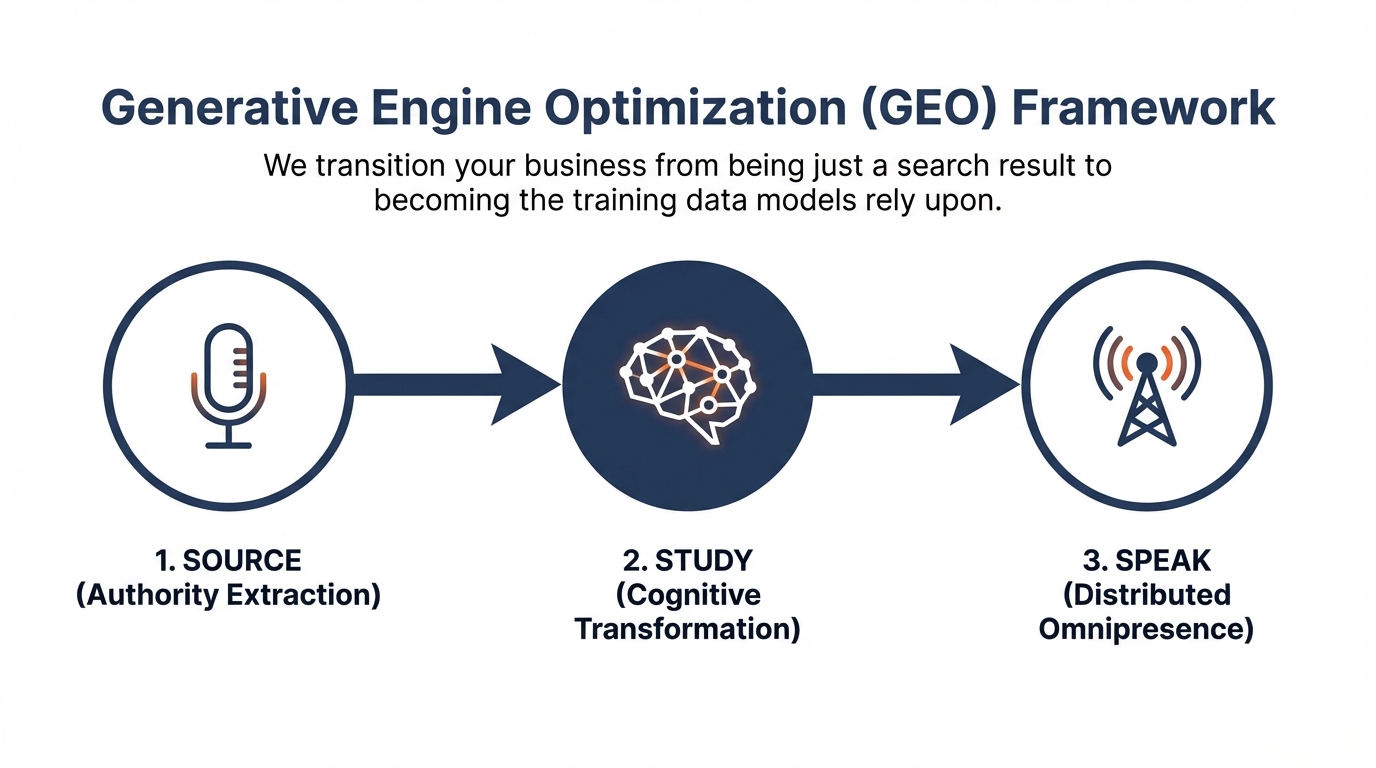
Authority Extraction
Cognitive Engine Transformation
Distributed Omnipresence
The Source phase runs on an unscripted, video-first interview session designed to extract ground truth from the expert. A podcast is a publishing format. The unscripted interview session is the production engine that captures the raw expertise before any of that publishing happens.
The interview sessions are deliberately conversational rather than scripted. The format produces three things scripted content cannot: natural-language explanations that match how buyers actually ask questions, specific examples and stories that ground abstract claims in real practice, and the verbal nuance AI engines now favor over polished marketing copy. The session itself takes approximately ninety minutes per month of the expert’s time. Everything downstream (production, atomization, distribution, and tracking) is handled by JAR Consulting Group.
The distinction matters. The methodology does not trick AI. It builds the infrastructure AI uses to make recommendations, then ensures that infrastructure points to the brand consistently across every source AI weighs.
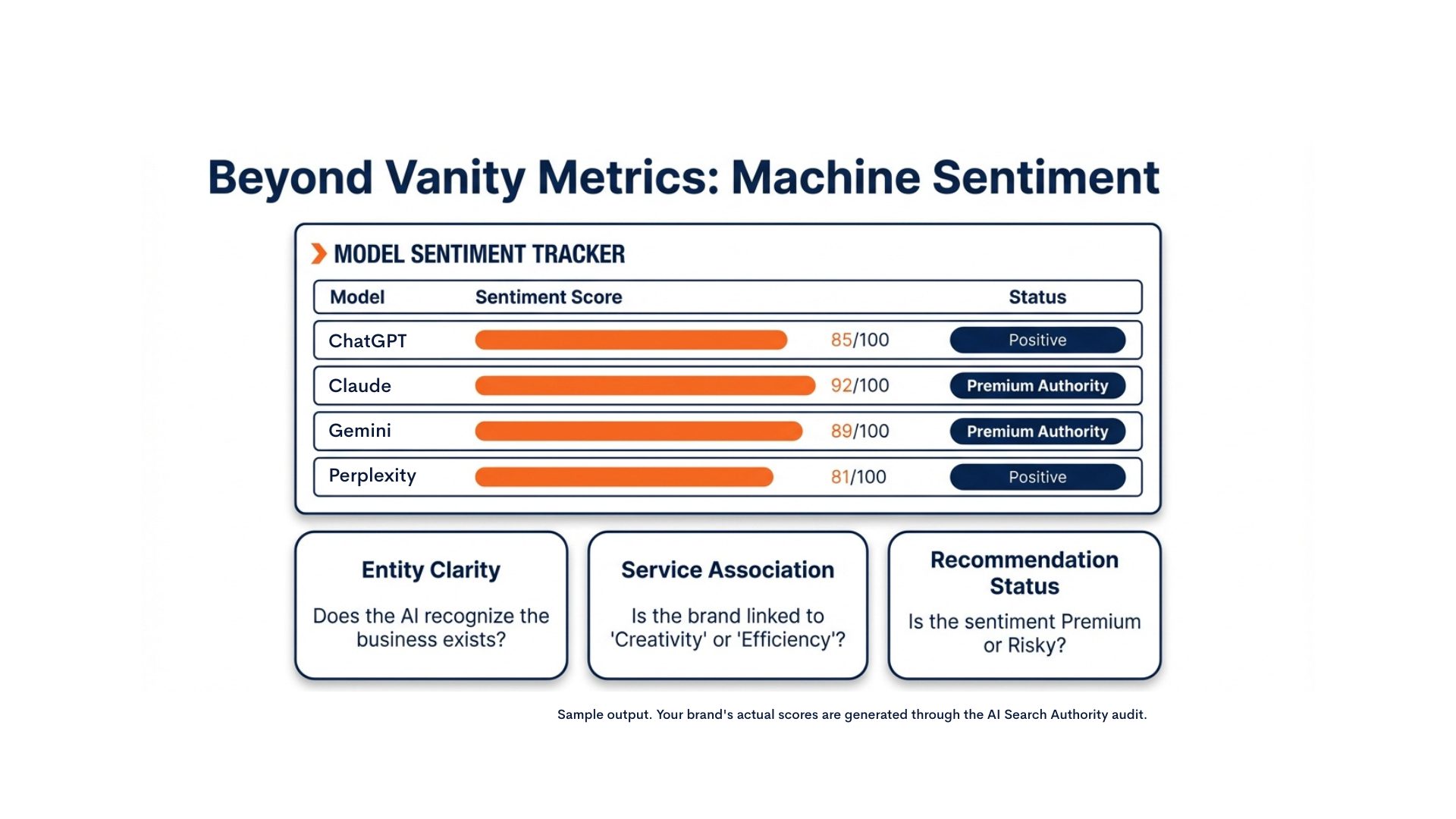
Traditional search optimization measures rankings. AI Search Authority Engine™ measures something different: machine sentiment. The methodology tracks how each major AI engine perceives, describes, and recommends the brand, and reports the score back monthly. Three dimensions are measured continuously across ChatGPT, Claude, Gemini, and Perplexity.
Speak naturally about the topics that demonstrate expertise.
Approve the atomized assets before publication.
JAR Consulting Group handles production, atomization, distribution, schema implementation, entity mapping, sentiment tracking, and reporting. Authority compounds with consistency. The methodology is designed to make consistency effortless for the expert, because the expert’s time is the constraint that determines whether the program runs for one month or for twelve.
AI Search Authority Engine™ is delivered through custom-scoped monthly engagements designed to produce compounding authority over six to twelve months. Each engagement is sized to the client’s category competitiveness, current entity authority, and pace-of-citation objectives.
The window for establishing entity authority in AI training data is open now and will not stay open indefinitely. Once an AI engine establishes a recognized market leader in a category, displacing that leader requires roughly ten times the effort of being recognized first. First-mover advantage is the defensive moat.
Custom scoping above the entry point based on engagement depth, content velocity, and competitive displacement requirements. Six-month minimum engagement recommended; twelve-month engagements recommended for clients pursuing deep category ownership in competitive verticals.
AI Search Authority Engine™ is JAR Consulting Group's proprietary methodology for engineering how AI systems understand, trust, and recommend a brand. It produces the public record AI relies on, structures it for machine ingestion, and distributes it across platforms AI engines weight most heavily, so the brand becomes the cited answer when buyers ask.
Traditional SEO optimizes for blue-link rankings on Google. AI Search Authority Engine™ optimizes for citation inside generative AI answers from ChatGPT, Claude, Perplexity, Gemini, and Google AI Overviews. Brandlight's 2026 research shows the overlap between top Google rankings and AI-cited sources has dropped from roughly 70 percent to under 20 percent.
Generative Engine Optimization, or GEO, is the practice of structuring content, schema, and entity signals so AI engines cite a brand as the recommended answer to user queries. GEO replaces traditional ranking metrics with citation metrics. AI Search Authority Engine™ is JAR Consulting Group's GEO methodology.
Gartner forecasts a 25 percent decline in traditional search volume by 2026 as users shift to AI-native discovery. Buyers increasingly receive a single definitive answer from an AI engine rather than ten ranked links. If a brand is not cited inside that answer, the buyer never reaches the brand's website.
AI engines calculate probability, not truth. They infer authority from consistent signals across their training data — the same entity facts, expertise claims, and third-party corroboration appearing across Wikipedia, editorial publications, Reddit, directories, and the brand's own structured content. Consistency across sources raises probabilistic confidence and triggers citation.
Source captures expert knowledge through unscripted interview sessions called Streamcast. Study transforms that source material into structured assets — FAQs, articles, case documentation, video shorts, quote cards — engineered for AI ingestion. Speak distributes those assets across the platforms AI engines treat as corroboration sources, so multiple trusted records agree.
Streamcast is the unscripted video interview format used in the Source phase to extract authentic expertise. The format produces natural-language explanations, specific examples, and verbal nuance that AI engines favor over polished marketing copy. One thirty-minute Streamcast session generates weeks of atomized content downstream.
Content atomization is the process of transforming a single piece of source material — a Streamcast interview — into multiple structured assets engineered for different AI ingestion patterns. One interview becomes FAQ articles, structured blog content, case studies, LinkedIn posts, video shorts, and quote cards, each optimized for a different signal layer.
Entity clarity is the consistency of identity signals — name, address, services, ownership, founding history — across every record AI engines have been trained on. When ChatGPT, Claude, Perplexity, and Gemini all see the same facts about the brand, they recognize it as a distinct entity. Inconsistencies suppress every other signal.
Machine sentiment scoring measures three dimensions across each major AI engine: Entity Clarity (does the AI recognize the business exists), Service Association (what attributes the AI links to the brand), and Recommendation Status (whether the AI names the brand when users ask for recommendations). Scores are reported monthly across ChatGPT, Claude, Gemini, and Perplexity.
AI Search Authority Engine™ engagements show measurable signal changes within thirty to sixty days as schema deploys, entity records consolidate, and atomized content begins indexing. Citation appearances in major AI engines typically begin in months three through five. Recognized market-leader positioning compounds across six to twelve months.
The methodology produces tracked improvements in three areas: AI citation count across ChatGPT, Claude, Perplexity, Gemini, and Google AI Overviews; sentiment score progression across Entity Clarity, Service Association, and Recommendation Status; and pipeline attribution from buyers who report discovering the brand through AI search. Reports are delivered monthly.
AI citations capture buyers earlier in the discovery journey, before traditional search behavior begins. Brands cited as definitive answers receive direct buyer contact at higher trust levels than those discovered through ten-link search results. Pipeline attribution tracks which inbound conversations originated from AI-engine discovery.
Once an AI engine establishes a recognized market leader in a category, displacing that leader requires roughly ten times the effort of being recognized first. The methodology accounts for displacement strategy through targeted comparison content, expanded entity corroboration, and category-adjacent positioning that opens new citation surfaces.
Generative engines weight content freshness heavily. GEO research shows content unrefreshed for more than ninety days begins losing AI visibility. JAR Consulting Group operates a structured ninety-day refresh cycle on all published assets, updating statistics, examples, and supporting context to maintain citation eligibility.
The recurring time commitment is approximately ninety minutes per month — the Streamcast interview session plus brief approval review of atomized assets before publication. JAR Consulting Group handles production, atomization, distribution, schema implementation, entity mapping, sentiment tracking, and reporting on behalf of the client.
Standard monthly deliverables include the Streamcast interview session, atomized content assets across multiple formats, schema implementation on new content, distribution across the brand's owned and earned channels, machine sentiment scoring across the four major AI engines, and a monthly authority report documenting citation progress and recommended adjustments.
The recommended minimum engagement is six months. AI authority compounds across consistent monthly signal generation; engagements shorter than six months produce signal but rarely produce recognized market-leader positioning. Twelve-month engagements are recommended for clients pursuing deep category ownership in competitive verticals. Each engagement is custom-scoped to category competitiveness and citation objectives.
Success is reported monthly across three documented metrics: machine sentiment score progression by AI engine, citation count by query category, and pipeline attribution from AI-discovered buyers. Quarterly reports add competitive citation share-of-voice and recommended methodology adjustments. All reports are delivered as structured documents alongside live dashboard access.
Established authority requires defense. After the initial engagement, clients typically continue at a sustainment cadence — fewer Streamcast sessions, ongoing refresh of existing assets, continued sentiment tracking, and competitive defense against displacement attempts. Authority earned during the build phase erodes within twelve months without sustainment.

© 2026 JAR Consulting Group. All Rights Reserved. Privacy Policy | Terms of Service