1 min read

How Does AI Decide Which Businesses to Recommend?

When customers ask ChatGPT, Gemini, Claude, or another AI platform to recommend a business, simply ranking well in Google may no longer be enough. In this episode of The Unlearning Lab, host Mike Downer talks with Kevin Wosmansky, founder and CEO of JAR Consulting Group, about how AI evaluates businesses and why LLM reputation management is becoming an important part of digital visibility. The key takeaway is simple: AI needs clear, consistent evidence about who a business is, what it does, where it operates, and why customers should trust it.

AI Recommendations Depend on Understanding and Confidence

According to Kevin, when someone asks an AI platform for the “best” company for a particular service, the system is trying to understand the person’s intent and return an answer it has enough confidence to support.

Depending on the platform and question, that answer may be informed by websites, search results, reviews, directories, authoritative sources, and other information available online. This means visibility alone is not the entire goal.

As Kevin explains, businesses should ask three questions: Does AI know who you are? Does it understand what you do? Does it consider you credible?

That credibility may be supported by information spread across a company’s broader digital footprint rather than one optimized webpage.

Does Strong SEO Guarantee AI Visibility?

A strong SEO foundation helps, but it does not guarantee that an AI platform will recommend a business.

Kevin describes the relationship as “yes and no.” Businesses performing well organically already have useful signals in place, including crawlable webpages, relevant content, and established online authority. However, good Google rankings do not automatically translate into citations or recommendations from large language models.

Traditional SEO still matters. In its guidance for AI-powered search experiences, Google emphasizes making content accessible to crawlers and creating useful, original information rather than relying on special AI-specific optimization tricks.

The larger shift is that businesses now have to think beyond individual rankings and consider how clearly their overall online presence communicates expertise, relevance, and legitimacy.

Why Consistency Across the Web Matters

AI needs enough information to connect a business with its services, location, expertise, and reputation.

Kevin points to websites, social profiles, directories, reviews, YouTube, media appearances, podcasts, and independent third-party references as pieces of that digital footprint. Repeated, consistent information can make it easier for systems to understand the business as an identifiable entity.

Even basic organizational information matters. Google’s Organization structured data documentation recommends clearly identifying details such as a company’s name, address, telephone number, website, logo, and other information that helps search systems understand an organization.

Independent reputation sources can add another layer of evidence. Organizations such as the Better Business Bureau maintain business profiles, reviews, complaint information, and other marketplace data that consumers can use when evaluating companies.

The goal is not simply to appear everywhere. The information across those sources should consistently describe the same company, services, expertise, and location.

Real Expertise Creates Stronger Digital Evidence

One of Kevin’s strongest points is that businesses should demonstrate actual expertise rather than relying entirely on generic content.

“A knowledgeable business owner can answer a question for ten minutes in a way that a generic writer couldn’t answer authentically,” he says.

Firsthand stories, detailed explanations, case studies, interviews, and expert commentary give companies opportunities to create information that competitors cannot easily duplicate.

This aligns with Google’s guidance for creating helpful, reliable, people-first content, which encourages original information, firsthand knowledge, clear sourcing, and demonstrable expertise.

AI can still help businesses research, organize, or produce content more efficiently. The problem comes when automation replaces real insight. Large volumes of generic content do little to establish why a particular company should be viewed as an authority.

Why Good Businesses Can Still Be Invisible to AI

A legitimate company can provide excellent service and still have a weak presence in AI-generated answers.

Kevin describes the missing ingredient as “digital evidence.” Businesses need enough publicly available information to demonstrate that they are established, knowledgeable, and credible.

Weak websites, thin service pages, limited original content, few reviews, and little expert commentary can all make it harder for AI systems to understand a company.

That creates an important distinction between real-world reputation and digital reputation. A company may be well known to existing customers while still giving search engines and AI platforms very little information to work with.

Start by Measuring Your Current AI Visibility

For businesses that rarely appear in AI recommendations, Kevin advises against immediately publishing hundreds of new articles.

Instead, start with a baseline.

Search for the questions customers actually ask. See which companies AI recommends. Check whether your business appears, how it is described, what sources are cited, and where competing companies have stronger evidence.

From there, businesses can identify whether they need stronger service pages, more expert content, better reviews, clearer company information, more third-party mentions, or a stronger overall SEO foundation.

Ultimately, effective LLM reputation management begins with understanding the reputation and evidence AI systems can already find. As Kevin summarizes, “You cannot improve your AI visibility until you understand your current AI visibility.”

FAQs

Can Good Google Rankings Help a Business Appear in AI Recommendations?

Yes. Strong SEO improves discoverability and authority, but high rankings alone do not guarantee AI recommendations.

What Information Should AI Understand About a Business?

It should clearly understand the company’s identity, services, service area, expertise, and credibility.

Do Online Reviews Matter for AI Visibility?

They can. Reviews provide third-party evidence about customer experiences and a company’s broader reputation.

Can Podcasts Help Establish Authority?

Yes. Podcasts allow business owners to demonstrate firsthand knowledge and create original expert content that can strengthen their digital footprint.

Should Businesses Mass-Produce AI-Generated Articles?

Not as a shortcut to visibility. Content should provide useful, original information and genuine expertise regardless of whether AI assists with production.

Where Should a Business Start Improving AI Visibility?

Begin by testing relevant customer questions across AI platforms and documenting whether the business is mentioned, recommended, cited, or accurately described.
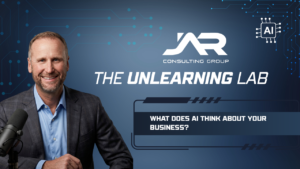

Mike Downer: Welcome to The Unlearning Lab, brought to you by JAR Consulting Group. I’m your host, Mike Downer. Once again, I’m joined by Kevin Wosmansky, founder, CEO, president, and head of housekeeping. How are we doing today, Kevin?

Kevin Wosmansky: Doing great, Mike. How are you doing, bud?

Mike Downer: Good. Good, good. Usually, it’s janitorial services, but today I figured I’d change it up.

Kevin Wosmansky: I noticed that. I kind of like that one. I did have to take all the garbage bags out at the office the other day, so that is a fair statement.

Mike Downer: That’s fair. Maintenance, housekeeping, you know, this time you can go make a bet or something.

Today, Kevin, you and I were talking, and we decided that we’re going to talk about how ChatGPT decides which businesses to recommend. So I guess we’re going to talk about something every business owner should be thinking about. When someone asks ChatGPT, Gemini, or other AI platforms for a recommendation, how does AI decide which businesses to recommend?

Kevin Wosmansky: Great question, Mike. When someone asks ChatGPT, “Who’s the best company for X?” what’s actually happening behind the scenes is that it’s trying to understand the user’s intent and produce an answer it has enough confidence to stand behind. That’s the simplest way to explain what is happening.

Mike Downer: Okay. So when someone asks, “Who’s the best company for something?” what is happening behind the scenes?

Kevin Wosmansky: Depending on the AI platform and the query, that answer can draw from learned information, web search, retrieval, authority sources, reviews, directories, company websites, and all kinds of other information that’s available to it.

I think the important question for businesses is whether AI can clearly understand who you are, what you do, and why you’re credible.

Everybody is asking us right now, “When someone asks ChatGPT, ‘I’m looking for XYZ,’ why am I not showing up?” Again, it breaks down to this: Do large language models know who you are? Do they know what you do? And do they think you’re credible?

That last part—do they think you’re credible—is massive. I can’t stress that enough.

Mike Downer: That answers the question pretty well. So AI doesn’t need to just find your business. It needs enough evidence to understand your business and trust you. Is that what you’re saying?

Kevin Wosmansky: Yeah. AI isn’t simply displaying blue links like a traditional Google search was.

What we’re trying to explain to our customers, and what we help our customers with, is this idea of “training AI.” You can’t really train AI in the sense that you go out and tell it what to do. That’s not going to happen.

What you can do is build up your company brand, your personal brand, and your credibility online. How do you do that? There are all kinds of review platforms. There’s participating in different online forums and blogs. There are podcasts like this. There’s getting interviewed by your local news agency. All of these different things help build your credibility.

So when we talk about how you show up and become credible when someone asks ChatGPT, Gemini, Claude, or any of the AI models, that’s what we’re talking about. What does your online brand look like?

Now we can get even more specific and ask: What was the query? What was the prompt? When someone prompts ChatGPT, that’s different from someone doing a keyword search on Google. That’s another thing we’re trying to get businesses to understand.

Mike Downer: Wait a minute, Kevin. If I’m already ranking well on Google, doesn’t that mean ChatGPT will recommend me too? I mean, come on, man.

Kevin Wosmansky: Great question, Mike. My answer is yes and no.

Yes, if you’re already showing up and you already have a very strong organic SEO foundation, that is absolutely going to help you get recommended, cited, and mentioned on ChatGPT or any of the other large language models. So yes, it is important. You need a strong SEO foundation in order to get cited and recommended.

However, just because you’re getting found on Google and you have a strong SEO foundation under you does not mean you’re automatically going to get cited and recommended.

So yes, it matters if you’re showing up on Google. Absolutely. But no, it does not mean you’re automatically going to show up when somebody prompts ChatGPT, Gemini, or another AI platform with something related to your business.

Mike Downer: All right, then I guess the key question is: What does AI need to understand about my business before it can confidently recommend it?

Kevin Wosmansky: Good question, man. AI needs to understand who you are. I’m going back to what I said earlier. It needs to understand what you do, where you do it, and why you’re credible.

That information comes from your website, your social media profiles, and third-party sources. Say somebody was talking about your business on Reddit. That’s huge.

Unlike traditional search, AI doesn’t just look at your website, although your website is critical. It also looks at third-party sources to validate whether you’re credible.

Mike Downer: Okay. How important is consistency across the internet?

Kevin Wosmansky: Pretty important, Mike. AI doesn’t just need to find your business. It needs enough evidence to understand and trust your business.

How does it understand and trust your business? By seeing you in multiple places and seeing your business show up in different directories and other places online. It needs to be able to see your business on YouTube. It needs to understand your website. Can it clearly read your website? That’s a whole other podcast episode.

So yes, consistency absolutely matters. But the key thing I would want to impress upon people is this: AI doesn’t just need to find your business. It needs enough evidence to understand and trust your business. I think that’s probably the most important takeaway.

Mike Downer: Very good. So it kind of sounds like when I was dating Carrie. She needed to trust me before she would hold my hand.

Kevin Wosmansky: Yeah, yeah. You kept it clean. It’s a good thing Carrie didn’t have AI when she first met you thirty-some years ago. She might have been able to find something a little bit better. I’m just saying.

Mike Downer: Oh, dude, she didn’t need AI for that.

Let’s get back to what we were talking about. You mentioned reviews, citations, directories, and all your fancy words that you love to use all the time. What roles do reviews, citations, directories, and third-party websites play in this whole scheme of things?

Kevin Wosmansky: Quite a bit, actually. I’ll go back to what I just said a second ago. If AI cannot find you, it’s not going to mention you, cite you, or recommend you.

When you talk about things like citations and directories, those have always been very important from an SEO standpoint. That holds true today.

Is your website linked to or associated with things like the Better Business Bureau? There are all these different independent third-party places that Google has traditionally looked at, and AI is looking at those too.

So the short answer is: it matters a lot.

Mike Downer: I have another question for you. Why does demonstrating actual expertise matter now more than it ever has?

Kevin Wosmansky: I’d say a knowledgeable business owner can answer a question for ten minutes in a way that a generic writer couldn’t answer authentically.

I bring that up as an example because the world is changing so much with AI. You have to demonstrate that you’re an expert. I mean, talk about it. I’m a real person right now. I’m not AI.

Now, did we use AI to help us prepare this content? Absolutely. What would have taken us hours to prepare, we were able to do in fifteen to twenty minutes.

But AI is not sitting here right now. AI is not the one that has met with business owners. AI is not the one that has real-world experiences. I am. I’m the one who sees firsthand how this is impacting customers and real-world stories.

That’s why it’s really important. Business owners today can answer questions for ten minutes that generic writers couldn’t answer authentically.

As we move forward, I think it’s really important that business owners, sales reps, and others demonstrate real expertise.

Mike Downer: I know there are a lot of business owners out there who run excellent businesses. There are hundreds of thousands of legitimate businesses. Why is it that sometimes legitimate businesses are practically invisible to AI?

Kevin Wosmansky: Usually, it’s not because they’re bad businesses. They simply haven’t built enough digital evidence.

Think about that phrase: digital evidence. It’s almost like you’re trying to prove your case. You’re trying to prove to Perplexity and Copilot that your business is credible.

“Look, we know what we’re doing. We have examples, case studies, and stories. We’ve done all this.”

I believe the business world is going to become a lot more competitive in a good way because businesses need to prove they’re legitimate. Let’s be real: if you’re a shady business and you’re not doing right by people, it’s going to get a lot harder to keep that quiet.

The things we’ve seen with businesses include weak websites, very generic service pages, not a lot of original content, weak reviews, and not a lot of expert content or testimony. These are the things that are going to start making a real difference.

In the old world of Google search, you didn’t have to do a lot of that and you could still do some things to get found. But now, you could be the best company in your market and still not be very visible to AI because of these issues.

That’s an important point. People are starting to use AI to determine whether a business is real and legitimate.

Mike Downer: Fair enough. We’ll start winding this one down. The last question I’ll ask you, because I’ve been picking your brain quite a bit, is this: I’m Joe Schmoe Hardware Store, and you’ll never see me anywhere. Where should I start? Where should a business start if it hasn’t already started doing this?

Kevin Wosmansky: The first thing I’m going to tell you is this: if you’re a business and you’re not being recommended or found right now on any of the large language models, do not start by publishing hundreds of AI-written articles and AI-written blogs and posting them to your website.

Mike Downer: Why not?

Kevin Wosmansky: It’s not helping you, because AI knows if it’s AI-written content. Let’s be really clear about that.

It’s funny, Mike. I have a couple of seniors in high school, and it’s hilarious listening to them talk about friends who are doing homework assignments and writing papers with ChatGPT. Guess what? The teachers have AI tools that tell them whether it was written with ChatGPT.

What I would tell a business owner is to start by measuring. What are the questions your customers are asking you? Which companies does AI currently recommend? Are you mentioned? Are you cited? How does AI describe you? What sources are influencing those answers?

I would start by measuring those things. Ask your favorite AI to do a full search on you, your website, and your competitors.

I’ve seen so many examples of people who just started mass-producing AI-generated content. I see marketing companies out there telling people, “We’re going to mass-produce AI content.”

Here’s the deal: if it’s not authoritative, original, and real, AI doesn’t want to recommend it.

So the starting point for businesses is to measure where you are. You need to understand what AI currently thinks about your business.

A lot of companies like mine take clients through that journey. We walk them down that road and help them. Obviously, that’s a big reason why we’re doing this podcast, Mike. We’re trying to educate people on what they need to do.

I get asked this every single week, if not every single day: “How do I get ChatGPT to recommend my business?” There isn’t one straight-line answer for that. It’s based on your industry and your business. Some businesses are extremely competitive. Other industries are not as competitive.

So that would be the start. Start by measuring your business. Start by understanding what AI currently thinks about your business.

Mike Downer: Perfect. That sums it up. Now everybody basically knows how to get started. That was kind of the whole point of this podcast: to do a little bit of a business gut check, right?

Kevin Wosmansky: Right, Mike. The business gut check for the business owner is this: you cannot improve your AI visibility until you understand your current AI visibility.

You have to look in the mirror. I have to do it every morning, and it’s not very easy.

Mike Downer: All right, buddy. As always, it has been completely fun. You put way too much information in my stupid brain, but it’s always good to know you’re informing smarter people than me out there on what to do and how to do it.

As always, we appreciate the time you give us on The Unlearning Lab.

Kevin Wosmansky: Thanks a lot, Mike. Appreciate it, buddy. We’ll see you.

Mike Downer: Hey buddy, you take care, and I look forward to our next talk. Have a good one.

JAR Consulting Group helps businesses implement AI and become the recommendation when customers ask AI for what they need. GEO, AI implementation, and the AI Visibility Stack.

© 2026 JAR Consulting Group. All Rights Reserved. Privacy Policy | Terms of Service