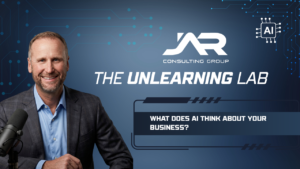
A business cannot train public AI models directly, but it can teach them to recognize and recommend its brand by building consistent, credible evidence about what it does across its website, reviews and third-party sources. That is the lesson of “What Does AI Think About Your Business?”, an episode of The Unlearning Lab in which host Mike Downer talks with Kevin Wosmansky, founder, president and CEO of JAR Consulting Group in West Des Moines, Iowa. “You don’t tell AI you’re an authority,” Wosmansky says. “You build evidence around your business that allows AI to reach that conclusion.”
What Does AI Understand About Your Business?
Wosmansky explains that AI is trying to understand who a business is, what it does, where it operates, who it serves and what it is known for. It can also compare companies with competitors when responding to a user’s question.
That means a company’s intended positioning may not match the picture AI has built. As Wosmansky says, “Your brand is no longer just what you say about yourself. It’s also what AI believes about you.” Closing that gap is the work of managing how AI models describe your brand, through the language in reviews, citations and third-party mentions.
For business owners, the takeaway is straightforward: Test whether AI can accurately describe and recommend the company, not merely whether it recognizes the name.
How Can You Find Out What AI Thinks About Your Business?
Ask AI the buying questions a customer would ask, Wosmansky advises, not “What do you know about my company?” That could mean asking who specializes in a service, which companies are recommended or who someone should hire, with your town added, such as Des Moines, Ankeny or West Des Moines, when you serve a local market.
He also suggests testing multiple AI platforms, not just one model: “Don’t just ask AI if it knows your business. Ask AI if it would recommend your business.” If the business never appears, or appears for the wrong services, owners have a clearer starting point for improvement.
Can AI Have the Wrong Impression of a Good Company?
Yes. A good company can still be represented by old or conflicting information. Wosmansky points to outdated services, old positioning, incorrect locations and stale content as potential problems. “Being invisible to AI is a problem,” he says. “Being misunderstood by AI can be an even bigger problem.”
This matters because AI search can retrieve current information from the web. OpenAI describes ChatGPT search as giving fast, timely answers with links to relevant web sources.
The practical lesson is that businesses need accurate and consistent information wherever their brand appears online.
Do Reviews Change What AI Thinks About a Business?
Yes. Reviews do more than show whether customers were satisfied. Wosmansky argues that the language inside reviews can help establish what a company actually does: “Reviews don’t just tell people whether you’re good. They help create a public record of what you’re good at.”
A vague review such as “Great people” offers little context. A review describing a specific problem, service and result gives customers and AI systems a clearer picture of the company’s expertise. In his view, fewer detailed reviews can sometimes provide more useful context than a large collection of generic praise. This is part of why Google reviews carry more weight in AI search than a star count suggests.
How Do I Improve My Brand’s Visibility in AI Search?
You improve your brand’s visibility in AI search by creating a consistent body of evidence, which is Wosmansky’s answer to the question.
That means correcting misinformation, improving the website, publishing genuine expertise, strengthening reviews, earning third-party validation and keeping business information aligned. Together, those steps build the evidence behind AI brand reputation.
That approach aligns with Google Search Central, which says helpful, reliable, people-first content and established SEO practices remain important for generative AI features.
Meanwhile, Microsoft Bing has introduced AI Performance reporting in Bing Webmaster Tools, which shows publishers how often their content is cited in AI-generated answers.
What Should a Business Do First?
Start with a baseline. Before spending money on changes, find out what AI knows, what it says, who it recommends and which sources it cites, then use those findings to create a roadmap.
How can a business train AI models to recognize and recommend its brand? Not by directly controlling public AI models, but by improving the public evidence those systems can discover, understand and retrieve.
Where Can You Watch the Full Conversation?
Watch the episode of The Unlearning Lab on YouTube to hear Mike Downer and Kevin Wosmansky break down AI visibility, reviews, brand signals and recommendation behavior in practical terms. The conversation gives business owners a clearer way to evaluate how AI understands their company and where improvements should begin today.
JAR Consulting Group helps businesses build that evidence through its AI Search Authority Engine™ program.
Frequently Asked Questions
How Can a Business Train AI Models to Recognize and Recommend Its Brand?
It cannot train public AI models directly. It can make its website, reviews, listings and third-party mentions describe the same services and expertise, so AI systems have consistent evidence to recognize and recommend it.
Can a Business Directly Tell ChatGPT to Recommend It?
No. A company cannot simply instruct a public AI system to recommend its brand. It can improve the quality and consistency of information available about the business.
What Should a Business Ask During an AI Visibility Audit?
Ask recommendation-focused questions based on customer intent, such as who offers a service, who specializes in it and which provider AI would recommend.
Why Can AI Misunderstand a Business?
Outdated pages, inconsistent service descriptions, incorrect locations and conflicting information can create an incomplete or inaccurate picture.
Do Reviews Matter for AI Visibility?
Yes. Detailed reviews can provide useful context about services, expertise and customer outcomes.
Should a Business Test More Than One AI Platform?
Yes. Different systems can return different answers and sources, so testing several platforms provides a broader picture.
What Should a Company Fix First?
Start with the audit. Identify inaccurate information, missing signals and inconsistent messaging before deciding which improvements deserve priority.
How Quickly Can AI Results Change?
There is no guaranteed timeline. Public information can be updated, but when and how an AI system reflects those changes will vary.