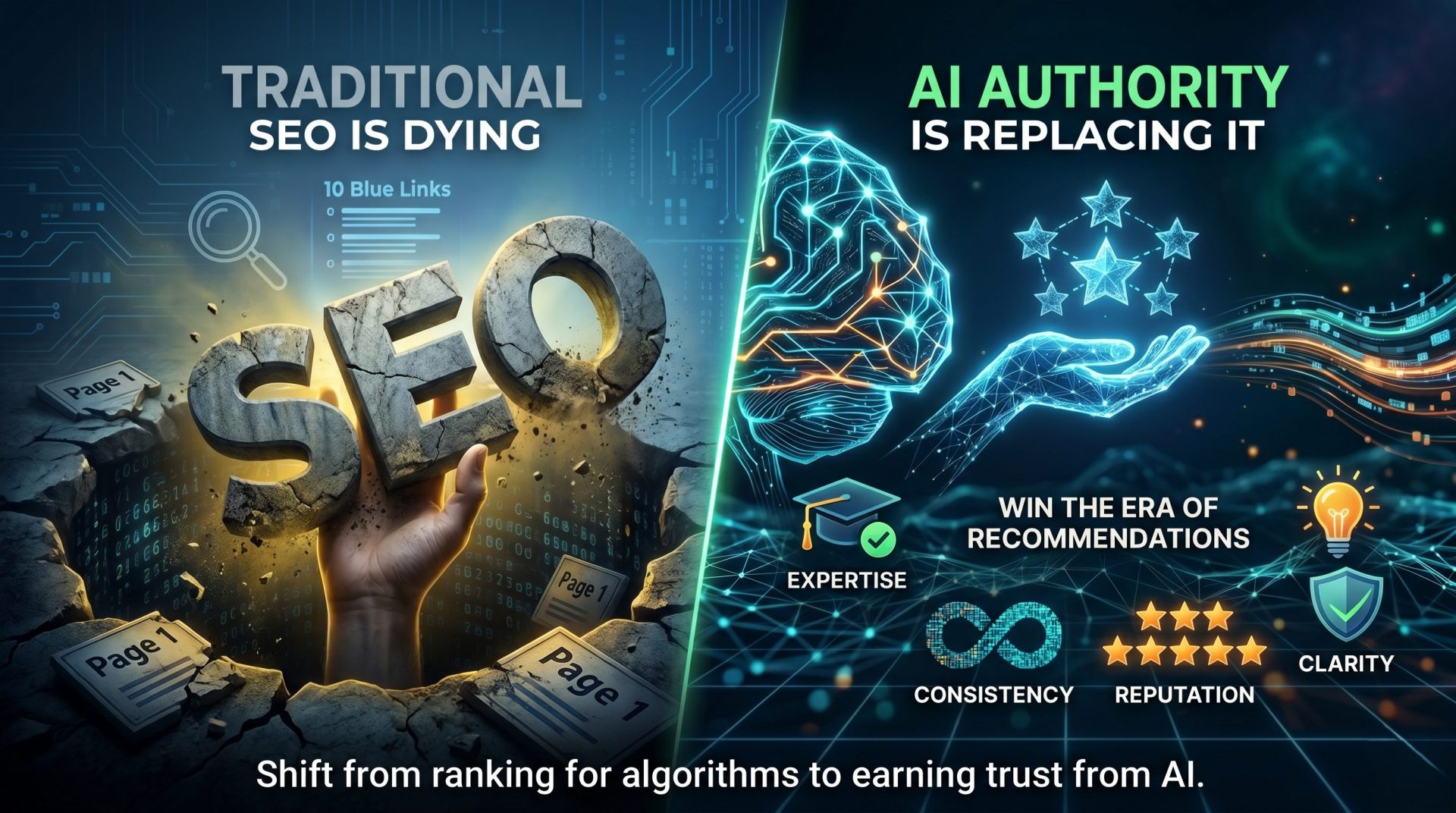
For years, businesses fought for visibility by chasing Google rankings. The strategy was simple: publish enough content, build enough backlinks, and hope your website landed on page one. But the internet is changing fast. Today, customers are no longer just typing searches into Google. They are asking AI assistants direct questions and expecting immediate recommendations. Businesses now want to know how to get your business recommended by ChatGPT, and the answer has very little to do with old-school SEO tactics.
The Search Engine Era Is Ending
Traditional SEO was built around keywords, backlinks, and ranking positions.
For over two decades, businesses optimized websites to satisfy Google’s algorithm. If you ranked high enough, traffic followed. Agencies sold ranking packages. Companies pumped out blog posts designed more for search engines than for real humans.
That strategy worked because search behavior was predictable.
A customer searched for “best roofing company near me.” Google displayed ten blue links. The customer clicked one.
But AI search changes the experience entirely.
Instead of scrolling through links, users now ask questions conversationally:
- “Who’s the most trusted roofing company in my area?”
- “What cybersecurity company should a small business hire?”
- “What’s the best accounting software for contractors?”
AI assistants like ChatGPT, Gemini, and Claude don’t simply show a list of websites. They synthesize information, evaluate authority, and generate recommendations.
That changes everything.
The businesses winning in AI search are not necessarily the ones gaming algorithms. They are the ones establishing undeniable authority.
AI Doesn’t Rank Websites the Same Way Google Did
Many business owners still believe AI search works exactly like Google search.
It doesn’t.
Large language models evaluate trust differently. They pull information from multiple sources, compare consistency, analyze reputation signals, and determine who appears most credible.
During the Unlearning Lab podcast, Kevin Wosmansky of JAR Consulting Group highlighted just how widespread this shift has become when he said:
“This is probably one of the most commonly asked questions in business today: ‘How do I get my business recommended by ChatGPT and AI assistants?’”
That question alone says a lot about where search behavior is heading.
Businesses are beginning to realize customers no longer want to spend time researching dozens of websites. They want trusted recommendations instantly.
AI systems are not simply indexing websites anymore. They are trying to identify authority.
That means businesses can no longer rely on outdated SEO tricks like:
- Thin content stuffed with keywords
- Buying low-quality backlinks
- Publishing hundreds of AI-generated articles
- Creating duplicate city pages
- Manipulating search rankings with technical loopholes
AI models are becoming increasingly effective at filtering out low-value content.
What they reward instead is expertise, consistency, reputation, and clarity.
Authority Is the New Ranking Factor
Businesses used to ask:
“How do we rank?”
Now the better question is:
“Why should AI trust us enough to recommend us?”
That shift is massive.
Authority in the AI era is earned through a combination of signals. No single tactic works alone anymore.
Content Quality Matters More Than Content Quantity
For years, SEO agencies pushed businesses to produce endless blog posts.
The logic was simple: more pages meant more opportunities to rank.
But AI search is changing the economics of content.
A business with 20 exceptional pieces of content may outperform a competitor with 2,000 shallow articles.
Why?
Because AI systems evaluate usefulness.
If your content genuinely answers questions better than competitors, AI is more likely to surface it.
That means businesses need to stop publishing filler.
Every article should:
- Solve a real customer problem
- Address common objections
- Explain pricing transparently
- Demonstrate expertise
- Include original insights
- Reflect actual human experience
One of the strongest moments in the podcast came when Kevin pointed out how businesses are often hesitant to answer pricing questions publicly.
That hesitation is understandable. Many companies fear competitors seeing their rates or strategies. But customers are already searching for those answers.
If customers want to know pricing, timelines, risks, or comparisons, businesses should answer them directly.
The companies that become trusted educational resources are the companies AI assistants are most likely to recommend.
AI Is Rewarding Entity Authority
One of the biggest shifts happening right now is the rise of entity-based search.
An “entity” is essentially a clearly understood identity.
AI systems want to know:
- Who are you?
- What do you do?
- Where are you located?
- What are you known for?
- Do other trusted sources recognize you?
This is why consistency across the internet matters more than ever.
During the podcast, Kevin expanded the conversation beyond technical SEO and brought attention to something many businesses overlook:
“I’d add one more thing: your brand identity.”
That statement matters because AI systems do not just analyze websites. They analyze overall brand consistency.
That means your business information should match everywhere:
- Website
- Google Business Profile
- Industry directories
- News mentions
- Podcast appearances
- YouTube descriptions
If your business details are inconsistent, AI systems may struggle to trust the information.
Think about how humans evaluate credibility.
If someone’s company name changes across platforms, their address differs online, and reviews are scattered, trust decreases.
AI systems work similarly.
Businesses with strong entity clarity create confidence.
Your Website Is No Longer Just for Humans
Most businesses still think websites exist primarily for customers.
That is no longer true.
Today, websites also serve AI crawlers. The structure behind your website matters almost as much as the content users see.
Modern AI search systems analyze:
- Schema markup
- Internal structure
- Metadata
- Semantic relationships
- Crawlability
- Content organization
- Accessibility
Many small business websites are already outdated.
A surprising number of websites were built for search algorithms from five years ago, not AI systems emerging today.
Why Schema Markup Matters
Schema markup is one of the clearest examples of how technical SEO is evolving into AI communication.
Schema acts like a translator between your website and AI systems.
It tells machines:
- This is a business
- These are reviews
- This is a service
- This is a FAQ
- This is pricing information
- This is a podcast episode
Without proper schema, AI systems may misinterpret or overlook valuable information.
Businesses investing in structured data today are positioning themselves ahead of competitors still relying on outdated SEO methods.
Reputation Signals Are Becoming Critical
Traditional SEO often prioritized backlinks.
AI authority prioritizes trust. That trust comes from reputation signals spread across the web.
The podcast discussion emphasized the importance of citations from authoritative sources.
That includes:
- Industry publications
- News websites
- Podcasts
- Forums like Reddit
- Professional organizations
- Review platforms
This matters because AI systems cross-reference information.
If respected sources consistently mention your company positively, your authority increases.
That is why public relations, podcast appearances, guest interviews, and thought leadership are becoming far more valuable than generic link-building campaigns.
Businesses that invest in visibility across trusted ecosystems are building long-term AI authority.
AI Can Detect Low-Quality Automation
One of the biggest mistakes businesses are making right now is assuming they can automate authority.
They can’t.
Many companies are flooding websites with AI-generated articles in hopes of dominating search results.
That short-term strategy is likely to fail.
Kevin captured the issue perfectly during the conversation when he joked:
“Honestly, I’m surprised you still have me hosting podcasts. I figured AI Mike would replace me eventually.”
The humor landed because it reflects a real concern businesses have right now.
Will AI replace human expertise?
The reality is more nuanced.
AI itself is not the problem.
The problem is low-quality, repetitive, generic content.
Businesses using AI to assist experts will likely thrive. Businesses using AI to replace expertise will likely disappear.
The difference matters.
AI can help organize information, improve workflows, and accelerate content production. But genuine authority still requires:
- Real experience
- Original perspectives
- Human insight
- Industry expertise
- Trustworthiness
Customers can feel the difference.
So can AI systems.
The Rise of Multi-Platform Authority
Another reason traditional SEO is fading is because customer discovery no longer happens in one place.
People consume information across multiple ecosystems:
- YouTube
- Podcasts
- TikTok
- Industry forums
- News sites
- AI assistants
Authority is no longer isolated to a single website.
Businesses now need ecosystem-wide visibility.
That means creating content in multiple formats.
Video Is Becoming a Major Trust Signal
AI systems increasingly analyze video transcripts, podcast discussions, interviews, and educational content.
A business owner consistently appearing in videos discussing industry topics demonstrates expertise in ways written content alone cannot.
This is one reason podcasts and YouTube channels are becoming powerful authority builders.
When business leaders publicly educate audiences, answer questions, and discuss industry trends, they strengthen credibility.
The businesses that show up consistently in educational conversations will likely dominate AI recommendations over the next decade.
Consistency Beats Virality
Many businesses chase viral moments.
But AI authority is usually built through consistency.
Publishing one great article every week for two years is often more valuable than publishing fifty rushed articles in one month.
Authority compounds over time.
AI systems observe patterns.
They notice businesses consistently producing useful information, earning positive reviews, receiving mentions, and maintaining active engagement.
Trust is not built overnight. It is accumulated.
The Businesses That Will Win the AI Era
The future belongs to businesses willing to become educators.
That is the real shift happening right now.
The companies winning AI search are not just selling products.
They are:
- Teaching customers
- Publishing expertise
- Answering questions transparently
- Building public trust
- Creating authentic content
- Establishing recognizable authority
This requires a completely different mindset than traditional SEO.
Old SEO often focused on manipulating visibility.
AI authority focuses on deserving visibility.
That distinction matters.
Businesses that continue relying solely on outdated SEO tactics may see diminishing returns over the next several years.
Meanwhile, businesses investing in expertise, reputation, and content quality are positioning themselves for long-term dominance.
Why This Shift Is Happening So Fast
Consumer behavior is evolving faster than many companies realize.
Younger audiences especially are becoming increasingly comfortable asking AI assistants for recommendations instead of browsing traditional search results.
It is easy to understand why.
AI offers:
- Faster answers
- Personalized responses
- Conversational interaction
- Simplified research
- Reduced information overload
Instead of clicking through ten websites, users can simply ask one question.
That convenience changes consumer expectations.
Businesses must adapt to where customer attention is moving.
Ignoring AI search today is similar to ignoring Google search in the early 2000s.
Some businesses will adapt early.
Others will realize the shift only after competitors have already established authority.
What Businesses Should Do Right Now
The transition from SEO to AI authority may sound overwhelming, but businesses do not need to panic.
They do need to evolve.
The smartest move companies can make today is focusing on long-term credibility instead of short-term ranking tricks.
That includes:
Build a Technically Strong Website
Your website should be modern, fast, structured properly, and understandable by AI systems.
If your website has not been updated in years, now is the time.
Create Content Around Real Customer Questions
Listen to your sales calls.
Review support emails.
Analyze the questions customers repeatedly ask.
Then answer those questions publicly with depth and transparency.
Strengthen Your Online Reputation
Actively manage reviews.
Encourage satisfied customers to share experiences.
Build trust signals consistently.
Invest in Thought Leadership
Appear on podcasts.
Publish educational videos.
Contribute insights to industry publications.
Share expertise openly.
Focus on Authenticity
Customers are increasingly skeptical of robotic marketing.
Human expertise stands out.
Businesses that communicate with clarity, honesty, and authority will separate themselves from competitors relying on generic automation.
The Future of Search Belongs to Trusted Experts
The era of chasing rankings at all costs is fading.
AI search is fundamentally changing how information is discovered online.
Businesses can no longer depend solely on keyword tactics and algorithm loopholes.
The future belongs to organizations that build genuine authority.
That means becoming the business customers trust most — not simply the business that ranks first.
One of Kevin’s strongest observations during the podcast was when he acknowledged how much effort this process truly takes.
He pointed out that businesses are beginning to understand that visibility in AI systems requires consistency, investment, and long-term commitment.
That statement may be the clearest description of the future of digital visibility.
Businesses that commit to expertise, consistency, and credibility today are positioning themselves for the next generation of search.
And for companies wondering how to get your business recommended by ChatGPT, the answer is becoming increasingly clear: build enough authority that AI systems cannot ignore you.
Watch the Full Podcast Episode
Want to hear the full conversation behind these insights?
Watch the complete Unlearning Lab podcast episode featuring Mike and Kevin from JAR Consulting Group on YouTube. The discussion dives deeper into AI search optimization, authority building, entity clarity, schema markup, and what businesses need to do now to stay visible in the AI-driven future of search.
If your business is serious about staying competitive as AI transforms search behavior, this is a conversation worth watching.
Frequently Asked Questions
Is traditional SEO completely dead?
No. Traditional SEO still matters, especially for website structure, crawlability, and discoverability. However, rankings alone are becoming less important as AI assistants increasingly provide direct recommendations instead of lists of links.
What is AI authority?
AI authority refers to the level of trust AI systems place in a business or brand. It is built through expertise, consistent information, strong reputation signals, quality content, reviews, and authoritative mentions across the internet.
How does ChatGPT decide which businesses to recommend?
AI systems analyze multiple trust signals, including content quality, online reputation, third-party citations, reviews, entity consistency, and overall expertise demonstrated across digital platforms.
Why is entity clarity important?
Entity clarity helps AI systems understand exactly who your business is, what services you provide, and whether your information is trustworthy. Consistent business information across all platforms improves credibility.
Does AI-generated content hurt rankings?
Not necessarily. Low-quality, repetitive AI content can damage credibility. However, businesses using AI to support expert-created content can still perform well if the information is original, useful, and authoritative.
How important are online reviews for AI search?
Reviews are extremely important. AI systems often use review platforms as trust signals when evaluating businesses. Strong reviews and active reputation management can improve recommendation potential.
Why are podcasts and videos becoming more valuable?
Video and podcast content demonstrate real expertise and authenticity. AI systems increasingly analyze transcripts, discussions, interviews, and educational media when determining authority.
How long does it take to build AI authority?
Building authority is a long-term strategy. Most businesses should expect consistent effort over several months or years. Authority compounds over time through content, reputation, visibility, and trust.