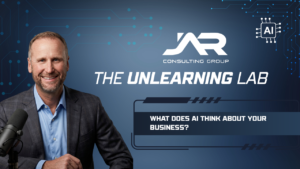
For years, ranking on the first page of Google was one of the clearest signs that a business had strong online visibility. That connection is now weakening. In an episode of The Unlearning Lab, host Mike Downer speaks with Kevin Wosmansky, President, Founder, and CEO of JAR Consulting Group, about Why Google ranking no longer guarantees AI visibility.
The key takeaway is that businesses must now optimize for more than traditional search rankings. Clear answer-first content, consistent brand messaging across independent platforms, structured website pages, and authoritative formats such as podcasts are becoming essential for earning citations in AI-generated answers.
What Does “The Great Divorce” Mean for Search Marketing?
“The Great Divorce” describes the growing separation between traditional Google rankings and AI-generated citations.
In the past, ranking among Google’s top results generally meant a business would receive greater visibility across search. According to Kevin, that relationship is no longer dependable. A company may hold the number-one organic position and still be absent from an AI Overview or chatbot recommendation.
“For years, the deal was simple,” Kevin explained. “If you ranked on page one of Google, you got visibility everywhere, including AI answers. That’s over.”
The shift means businesses can no longer assume that strong SEO performance automatically translates into visibility inside ChatGPT, Google AI Mode, AI Overviews, or other generative search platforms.
How Significant Is the Shift Toward AI Search?
AI search is no longer an experimental or niche channel. It is becoming a primary way people discover companies, compare services, and make purchasing decisions.
Kevin noted that Google’s AI products are already reaching enormous audiences. At the same time, a growing percentage of website visits may come from AI agents rather than human users. These agents crawl, interpret, compare, and evaluate content before deciding whether a business deserves to appear in an AI-generated answer.
This changes how companies should view website traffic. Businesses have traditionally focused on attracting human visitors, but they must now consider whether their content is understandable and trustworthy to AI systems.
As Kevin put it, “Increasingly, the traffic hitting your website isn’t a person—it’s AI deciding whether you’re worth citing.”
Why Are AI Systems Choosing Different Sources?
Traditional SEO has often focused heavily on keyword targeting, technical optimization, and backlink authority. Those elements still matter, but AI citation systems evaluate content differently.
AI systems look for information that can be easily extracted, understood, and verified. Two questions increasingly guide the process:
- Can the system pull a clear and trustworthy answer from the page?
- Do other credible sources support the same information?
This is why content structure is becoming so important. Long introductions, vague claims, buried answers, and inconsistent explanations make it harder for AI systems to identify useful passages.
By contrast, direct answers, descriptive headings, structured HTML, clear definitions, and self-contained sections make content easier to cite.
Kevin summarized the change clearly: “The brands showing up in AI-generated answers are the ones writing clear, direct, citable content—not necessarily the ones with the most links.”
What Are the Risks of Ignoring AI Visibility?
Businesses that ignore AI search may lose visibility even if their traditional rankings remain relatively strong.
Kevin described a B2B software company that intentionally avoided AI-focused optimization. The company promoted its content as human-written and AI-free, believing that this would help it stand apart. Instead, its organic traffic reportedly declined while competitors earned greater visibility through AI Overviews.
Reversing the damage required extensive content rewrites, added production costs, and months of lost opportunities.
The lesson is not that businesses should create robotic content or replace human expertise with AI. The lesson is that content must be structured for the way people and search systems now retrieve information.
Refusing to adapt offers little advantage when customers are increasingly relying on AI tools to recommend vendors, products, and service providers.
How Can Businesses Improve Their Chances of Being Cited?
Kevin outlined three practical priorities for businesses that want to remain visible.
First, companies should restructure their website content. Pages should provide direct answers near the beginning of each section, supported by clear explanations and useful evidence. Businesses do not need separate websites for people and AI. They need one high-quality publishing process that serves both.
Second, companies must build consistency across the internet. The way a brand describes its services, expertise, results, and positioning should remain aligned across its website, podcast appearances, social media accounts, industry publications, interviews, and research.
AI platforms often compare multiple sources before recommending a company. Contradictory or unclear messaging can weaken trust.
Third, businesses should invest in authoritative long-form content, including podcasts. A podcast episode can become a video, transcript, article, social media series, and collection of searchable expert insights.
Kevin shared that one of his clients recently received a prospect who said, “I asked ChatGPT, and it recommended you.” That experience shows how content investment can influence customer discovery even when the business cannot directly see the search journey.
Why Are Podcasts Valuable for AI Visibility?
Podcasts help businesses demonstrate expertise through natural, detailed conversations. They also create a repeatable source of original information that can be repurposed into structured written content.
A useful podcast transcript can support blog posts, FAQs, short videos, newsletters, social posts, and expert commentary. When those materials communicate a consistent message, they strengthen the signals AI systems use to understand the business.
Podcasting also gives leaders a way to discuss industry changes before competitors publish about them. That early authority can help position the company as a reliable source.
As Kevin explained, businesses now need to optimize for “ranking, citation, and agent trust simultaneously.”
Preparing for Search After “The Great Divorce”
Businesses should continue pursuing strong Google rankings, but rankings can no longer be the only measure of search visibility. The companies most likely to succeed will create content that is easy to understand, easy to verify, and consistent wherever their brand appears.
That means publishing direct answers, strengthening website structure, building authority through expert content, and paying attention to how AI agents interact with the site. Understanding why Google ranking no longer guarantees AI visibility is the first step toward competing in a search environment shaped by both traditional results and AI-generated recommendations.
FAQs About Google Rankings and AI Visibility
Does ranking first on Google guarantee an AI citation?
No. A business can rank highly in organic search and still be excluded from an AI-generated response.
Is traditional SEO still important?
Yes. Technical SEO, useful content, and search visibility still matter, but businesses must also focus on citation-ready structure and brand consistency.
What makes content easier for AI to cite?
Direct answers, descriptive headings, structured HTML, clear facts, concise passages, and supporting evidence make content easier to extract and verify.
Should businesses create a separate website for AI agents?
Usually not. Businesses should focus on improving their primary website so it provides a strong experience for both people and AI systems.
Why does brand consistency matter?
AI systems compare information across multiple sources. Consistent messaging can increase confidence that a company’s claims are reliable.
Can podcasts improve AI search visibility?
Yes. Podcasts create original expert content that can be transcribed, structured, and distributed across multiple platforms.
How can a business track AI visibility?
Businesses can monitor AI referrals, branded mentions, chatbot recommendations, AI crawler activity, and citations in AI-generated search results.
What should a business update first?
Start with high-value service pages and articles. Make the answers clearer, remove unnecessary introductions, strengthen headings, and ensure claims match what appears elsewhere online.