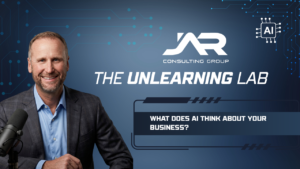
Artificial intelligence is rapidly changing how people search for information, evaluate businesses, and make purchasing decisions. In an episode of The Unlearning Lab podcast, host Mike Downer sat down with JAR Consulting Group Founder and CEO Kevin Wosmansky to discuss the top mistakes hiring a marketing agency AI search has created for modern businesses. Throughout the conversation, Kevin outlined five critical mistakes companies make when selecting a marketing partner: relying on outdated keyword strategies, falling for agencies that sell AI buzzwords without real technology, separating web development from search visibility, neglecting third-party brand presence, and focusing only on traditional metrics. Understanding these pitfalls can help businesses make smarter decisions and stay visible in an increasingly AI-driven search landscape.
Why Hiring a Marketing Agency Has Changed
For years, businesses evaluated marketing agencies based on familiar promises: higher Google rankings, more website traffic, and better keyword performance. While those factors still matter, AI-powered search engines and large language models are changing how information is discovered.
Today’s AI platforms don’t simply rank pages based on keywords. They analyze context, intent, credibility, authority, and how a brand is discussed across the web. As a result, businesses need agencies that understand both traditional search optimization and emerging AI search technologies.
According to Kevin, many businesses are still using evaluation criteria from a decade ago, even though the search landscape has fundamentally changed.
Mistake #1: Falling for Keyword Stuffing Strategies
One of the oldest SEO tactics is also one of the most outdated.
Keyword stuffing refers to cramming large numbers of keywords into website pages and blog content in an attempt to improve rankings. While this strategy was once common, it no longer aligns with how modern AI systems process information.
As Kevin explained:
“Large language models don’t care about keywords and keyword density. They care about semantic clarity and intent matching.”
Instead of rewarding repetitive keyword usage, AI systems prioritize content that directly answers questions and provides meaningful value. Long-winded articles designed solely to insert keywords can actually reduce content quality and user experience.
Businesses should be cautious of agencies that still promise rankings based primarily on keyword density or excessively long content without clear purpose.
Mistake #2: Buying GEO Services Without Understanding the Technology
Generative Engine Optimization (GEO) has quickly become one of the hottest terms in digital marketing.
However, Kevin warns that many agencies are adding GEO to their service offerings without having the infrastructure necessary to deliver meaningful results.
Modern AI visibility requires sophisticated tools and processes, including:
- Entity mapping
- Schema markup
- LLMs.txt implementation
- AI crawler monitoring
- Sentiment analysis
- AI query simulations
When evaluating an agency, businesses should ask a simple question:
How do you measure and track AI visibility?
If the answer is vague or relies heavily on buzzwords, that should raise concerns.
Kevin emphasized that real AI optimization requires measurable technology, not just promises. Agencies should be able to demonstrate how they monitor AI crawlers, evaluate brand sentiment, and assess visibility across platforms such as ChatGPT, Gemini, and Perplexity.
Mistake #3: Separating Web Development from Search Strategy
Many businesses treat web development and SEO as two separate disciplines.
According to Kevin, that approach no longer works.
A visually impressive website may look great to human visitors, but if AI crawlers struggle to access and understand its content, the site can become virtually invisible in AI search results.
Modern websites need to balance two priorities:
Human Experience
Visitors expect attractive design, smooth navigation, and engaging experiences.
Machine Readability
AI systems need accessible code, lightweight architecture, and content structures they can easily crawl and interpret.
Kevin highlighted the growing importance of technical accessibility:
“Web development and AI optimization are married now more than they ever have been.”
Businesses investing in website redesigns should ensure that developers and search strategists collaborate throughout the process rather than operating independently.
Mistake #4: Ignoring Third-Party Brand Presence
Many organizations focus exclusively on improving their own website.
While website optimization remains important, AI systems evaluate much more than a company’s owned content.
Large language models are trained using information gathered from across the internet, including:
- Reviews
- Forums
- Industry publications
- News articles
- Community discussions
- Knowledge databases
- Social conversations
Kevin explained that AI systems establish trust through cross-referencing multiple sources. If no one else is talking about your brand, AI platforms may be less likely to recommend it.
This makes digital public relations, community engagement, reputation management, and thought leadership more important than ever.
A strong digital footprint extends far beyond your website.
Mistake #5: Measuring Only Clicks and Conversions
Traditional marketing reports typically focus on metrics such as:
- Website traffic
- Click-through rates
- Impressions
- Conversions
These metrics still matter, but Kevin argues they’re no longer enough on their own.
As AI-generated answers become more common, users often receive information directly within AI search interfaces before ever visiting a website. This means businesses need to monitor an additional metric: citations.
AI systems frequently reference specific brands, websites, and sources when generating recommendations. Tracking how often your business appears in these citations can provide valuable insight into your visibility within AI ecosystems.
Kevin noted that users arriving through AI recommendations are often highly qualified prospects because they are already deep into the decision-making process.
Businesses should ask agencies how they measure:
- AI citations
- Share of voice
- Brand mentions
- Directory presence
- AI referral traffic
These metrics are becoming increasingly important indicators of digital authority.
The Future of Marketing Agency Selection
The rise of AI search isn’t eliminating traditional marketing principles. Instead, it’s expanding the criteria businesses should use when evaluating marketing partners.
The agencies that thrive in this environment will combine:
- Strong technical SEO
- AI optimization capabilities
- Smart web development
- Brand reputation management
- Advanced analytics and reporting
As Kevin repeatedly emphasized throughout the discussion, visibility in AI search requires a broader strategy than simply publishing content and chasing rankings. Businesses need partners who understand how AI systems evaluate trust, authority, and relevance across the entire web.
The marketing landscape is evolving faster than ever. Businesses that continue evaluating agencies using outdated standards may find themselves falling behind as AI reshapes how customers discover and trust brands. If you’re evaluating agencies today, understanding these principles may help you avoid the top mistakes hiring a marketing agency AI search has exposed across the industry.
Frequently Asked Questions
What is keyword stuffing?
Keyword stuffing is the practice of excessively repeating keywords throughout content to influence search rankings. Modern AI systems prioritize relevance and clarity instead of keyword density.
What is Generative Engine Optimization (GEO)?
GEO focuses on improving visibility within AI-powered search experiences and large language models such as ChatGPT, Gemini, and Perplexity.
Why does website code matter for AI search?
AI crawlers must be able to access and interpret website content. Poor technical architecture can make content difficult for AI systems to read and understand.
What is third-party brand presence?
Third-party brand presence refers to mentions of your business on external websites, reviews, forums, directories, publications, and community platforms.
Why are citations becoming important marketing metrics?
AI systems frequently cite sources when generating responses. Tracking citations helps businesses understand their visibility and authority within AI-driven search experiences.
Are traditional SEO metrics still relevant?
Yes. Metrics such as traffic, conversions, and click-through rates remain valuable, but they should now be supplemented with AI visibility and citation tracking.
How can I evaluate a marketing agency’s AI expertise?
Ask how they track AI visibility, monitor AI crawlers, measure sentiment, implement structured data, and report on AI-generated citations.